
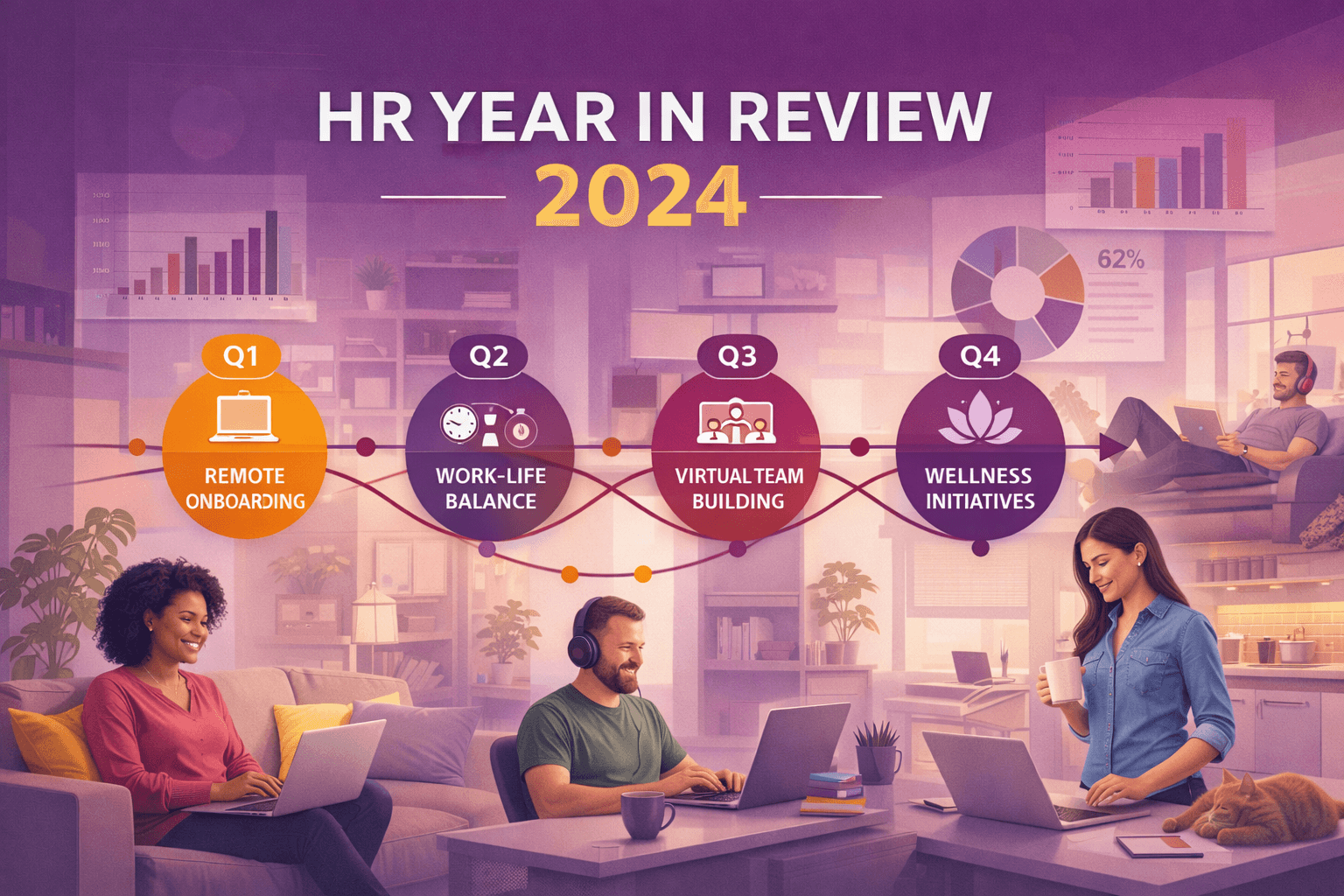
Remember when we all thought 2024 would be the year AI finally took over HR? Well, plot twist – it turns out humans are still pretty important after all. As we wrap up another whirlwind year in the HR world, let's cut through the noise and look at what actually happened versus what the "experts" predicted.
Spoiler alert: Some trends hit harder than expected, others fizzled out faster than a New Year's resolution, and a few surprises nobody saw coming completely reshaped how we think about work.
The AI Revolution That Wasn't (Quite Yet)
Back in January, every HR conference was buzzing about AI replacing recruiters by summer. LinkedIn was flooded with posts about chatbots conducting interviews and algorithms making hiring decisions. The reality? AI became a powerful sidekick, not the main character.
What we predicted: Full automation of recruitment processes, AI-driven performance reviews, and chatbots handling employee relations.
What actually happened: Smart organizations used AI to screen resumes and schedule interviews, but kept humans firmly in the driver's seat for final decisions. Companies like Unilever and IBM scaled back their AI-only recruitment experiments after discovering that human judgment remained crucial for cultural fit and complex role assessments.
The biggest win? AI-powered analytics finally helped HR teams prove their ROI. Tools that could predict turnover, identify flight risks, and optimize team compositions became game-changers – but always with human oversight.
The Lesson
AI amplifies human capability rather than replacing it. The most successful HR teams in 2024 were those that found the sweet spot between automation and human touch.
The Great Return-to-Office Reality Check
If 2024 taught us anything, it's that the remote work debate is far from settled. We started the year with bold predictions about mass returns to office life. CEOs made grand pronouncements, real estate markets held their breath, and HR departments prepared for battle.
The forecast: Major corporations would successfully mandate full returns to office, remote work would decline significantly, and hybrid models would prove unsustainable.
The reality check: Employee power proved stronger than executive mandates. Amazon's strict RTO policy sparked public pushback from employees. Meta quietly walked back some of its in-person requirements. Meanwhile, companies offering flexible work arrangements saw their talent acquisition advantage grow even stronger.
The data tells the story: Organizations that forced rigid RTO policies saw 15-20% higher turnover rates, while those embracing flexible hybrid models reported improved employee satisfaction and productivity metrics.
What Really Worked
Companies that succeeded focused on outcomes over attendance. They invested in better virtual collaboration tools, redesigned office spaces for collaboration rather than heads-down work, and trusted their employees to manage their own productivity.
The Mental Health Momentum That Stuck
Here's one prediction that not only came true but exceeded expectations. Mental health and wellbeing weren't just HR buzzwords in 2024 – they became business imperatives with measurable impact.
What we hoped for: Increased mental health awareness and some new employee assistance programs.
What we got: A complete transformation of how organizations approach employee wellbeing. Companies started measuring psychological safety alongside traditional KPIs. Mental health days became as normal as sick days. Leadership training included emotional intelligence as a core competency.
The numbers speak volumes: Organizations with comprehensive mental health programs saw 21% higher profitability and 37% better employee retention compared to those without.
The Unexpected Winner
Middle management finally got the support they needed. After years of being squeezed from above and below, 2024 became the year organizations recognized that manager wellbeing directly impacts team performance. Investment in manager training and support programs became a top priority.
The Skills Revolution Nobody Saw Coming
While everyone was focused on technical skills and digital transformation, the real revolution happened in soft skills. Critical thinking, adaptability, and emotional intelligence became more valuable than specific technical knowledge in many roles.
Companies shifted from hiring for experience to hiring for potential and learning agility. Internal mobility programs exploded as organizations realized they could develop talent faster than they could recruit it.
So, What's the Real Takeaway?
2024 reminded us that HR transformation isn't about choosing between human and digital – it's about creating better experiences for real people doing meaningful work. The organizations that thrived were those that stayed flexible, listened to their employees, and focused on outcomes rather than processes.
As we head into 2025, the lesson is clear: successful HR isn't about predicting the future perfectly. It's about building systems and cultures that can adapt quickly when reality doesn't match the forecast.
What surprised you most about HR in 2024? Share your biggest "didn't see that coming" moment in the comments – let's compare notes and get ready for whatever 2025 throws our way.